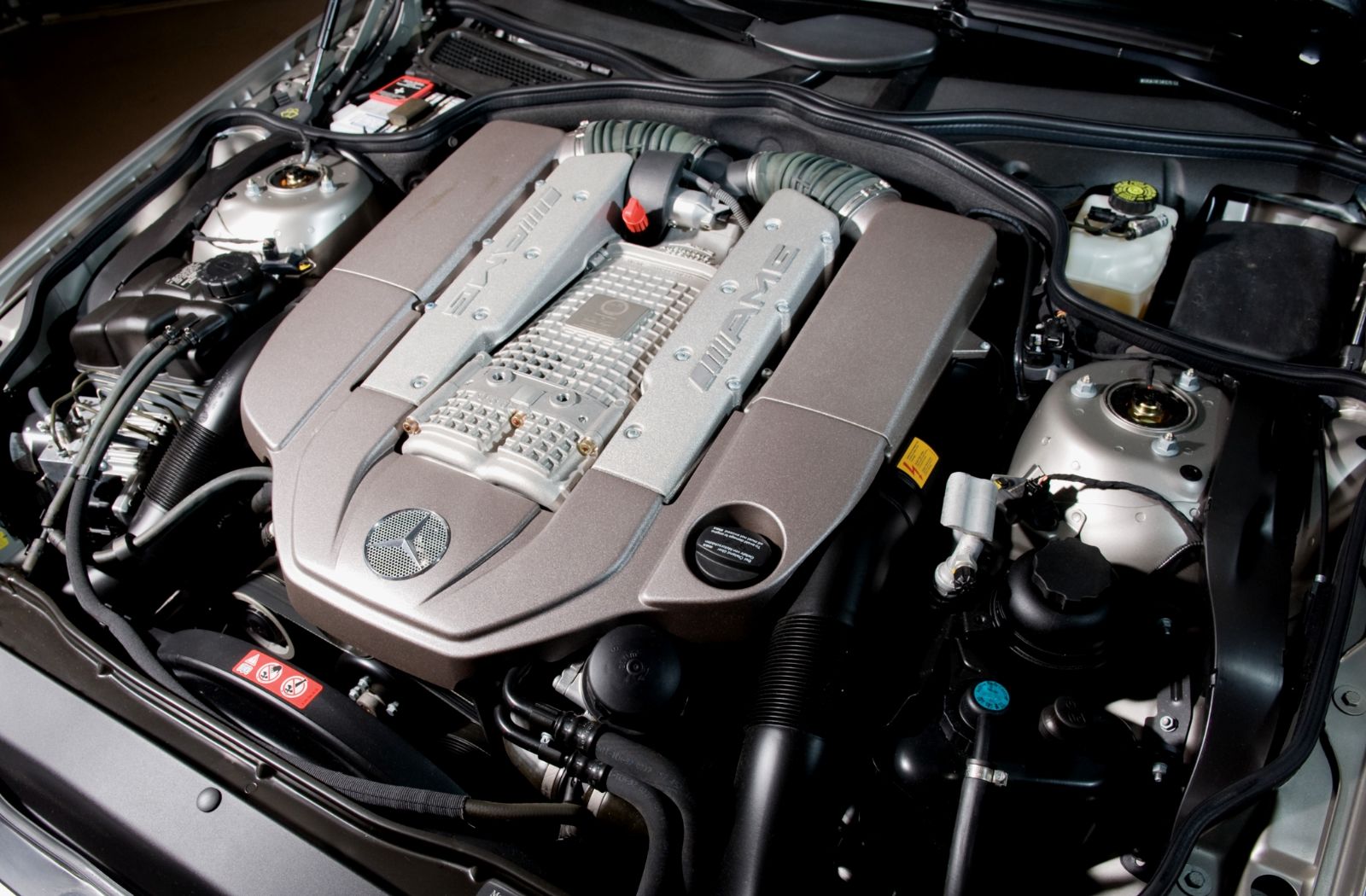

The Mercedes M113 V8: Overview, Applications, and How It Compares
The Mercedes-Benz M113 is one of the better-known modern Mercedes V8 engines. Introduced in the late 1990s, it powered a wide range of sedans, coupes, roadsters, and SUVs, including several high-performance AMG models. For many enthusiasts, it represents a middle ground between older, simpler Mercedes engines and newer, more complex powertrains. This article gives a straightforward overview of the M113, where it was used, some of the known trade-offs, and why Expedition Motor Company uses the LS3 V8 rather than the M113 as their gasoline engine option in the EMC 250GD.
Introduction to the M113 V8
The M113 is a 90-degree, single overhead cam (SOHC) V8 with three valves per cylinder and twin-spark ignition. It replaced the earlier M119 and was designed to be lighter, more compact, and simpler to manufacture, while meeting stricter emissions and efficiency requirements. Production began around 1997 and continued into the mid-2000s, with both naturally aspirated and AMG supercharged variants.
In stock form, the M113 is generally seen as a durable and smooth engine. It offers a broad torque band, good drivability, and a relatively simple layout compared with later DOHC, direct-injection Mercedes V8s. That combination is why it has a solid reputation among owners of period Mercedes sedans and SUVs, and why it often comes up in conversations about V8-powered G-Class models.
M113 Engine Specs (Overview)

Exact specifications vary by displacement and tune, but the core architecture is consistent across the family:
Displacements: Most common versions are 4.3L, 5.0L, and 5.4L (AMG).
Configuration: Aluminum block and heads, SOHC per bank, 3 valves per cylinder, twin-spark ignition.
Output range (naturally aspirated):
4.3L (M113.943 etc.): ~275–280 hp and ~295 lb-ft.
5.0L (M113.960/962 etc.): ~295–306 hp and ~340–350 lb-ft.
AMG supercharged variants (M113K):
5.4L with supercharger: ~469–500+ hp and ~516+ lb-ft, depending on model and market.
The M113 is typically paired with automatic transmissions (like the 5G-Tronic) and is known for smooth power delivery rather than high-rev drama. In everyday driving, it focuses on mid-range torque and refinement.
Factory Applications: Where the M113 Was Used

The M113 saw broad use across the Mercedes-Benz lineup. Key platforms include:
Sedans and wagons
E-Class (W210, early W211) – E430, E500, E55 AMG (M113K).
S-Class (W220) – S430, S500, S55 AMG (M113K).
CLS (early C219) – CLS500, CLS55 AMG (M113K).
Coupes and roadsters
CLK (C208/W209) – CLK430, CLK500, CLK55 AMG.
SL (R129/R230) – SL500, SL55 AMG (M113K).
SUVs and crossovers
ML (W163/W164) – ML430, ML500, ML55 AMG.
G-Class (W463) – G500 and early G55 AMG (naturally aspirated and later supercharged).
This spread illustrates why the engine is so visible in the Mercedes world. It powered everything from comfortable long-distance sedans to heavy SUVs and high-output AMG flagships.

Known Trade-Offs and Considerations
The M113 has a generally good reputation, but like any engine, it comes with its own set of considerations.
Over time, some owners report age-related issues typical of complex, multi-decade-old engines: oil leaks from gaskets and seals, wear in ancillary components, and the usual wiring and sensor aging found in modern engines. None of these are unique to the M113, but they are part of running an older, non-refurbished Mercedes powertrain.
Another consideration is parts and support in the long term. While core components and many service parts remain available, certain specific items (engine harnesses, model-specific accessories, AMG hardware) can be more specialized. For owners in markets without a strong network of Mercedes specialists, that can add complexity. As the fleet ages and more modern models replace M113-powered cars, the balance slowly shifts from “current” engine to “legacy” platform, with the usual implications for long-term support.
Finally, the M113 was designed to integrate tightly with period Mercedes electronic architectures—ECUs, control modules, CAN bus, and factory diagnostic systems. That is an advantage in original chassis, but it adds complexity if you start moving the engine into other platforms or blending it with non-OEM control systems. For a restomod program built around consistency, that integration work is non-trivial and needs to be weighed against other options.
Why EMC Uses the LS3 V8 (430hp)

EMC respects the M113 and its place in the G-Class story, especially in early G500 and G55 AMG models. For their own gasoline-powered G-Wagon builds, however, they choose the GM LS3 V8 rather than the M113. That decision is driven by practicality for the client, parts support, performance, and long history of use in many different applications.
Because the LS3 has been used so widely, it benefits from excellent parts availability and support. Service components, sensors, and consumables are straightforward to source, and a large number of independent shops are familiar with modern GM small-block V8s. For a client who prefers a gasoline V8 engine and plans to drive their vintage G for many years, that ecosystem matters. It simplifies maintenance, makes long-term ownership more predictable, and provides confidence that the engine can be serviced in a variety of locations, not just near a Mercedes specialist.

Given the LS3s they use are brand-new crate engines, it means they start from a fresh, warrantied baseline rather than a fully-restored engine. Their team has also engineered the surrounding systems—cooling, driveline, exhaust, electronic controls—specifically for the 250GD chassis. The result is a package that feels cohesive, with tuning and calibration tailored to how their clients will drive the vehicles.

EMC's Mercedes Powerplant Options

For clients who prefer to stay within the Mercedes family, EMC offers three OM-series diesel engines: the OM602, OM605a, and OM606a. The OM602 is the original 2.5L five-cylinder “million-mile” engine fitted to the 250GD Wolf. It is simple, mechanically straightforward, and delivers linear, usable power across the rev range. For many owners, it represents the most authentic expression of the 250GD, exactly how the Wolf was intended to feel when new.

The OM605 and OM606 turbodiesels build on that foundation with more power and refinement while preserving a period-correct character. The OM605 is a 2.5L turbocharged five-cylinder (225 hp / 300 lb-ft) that offers a noticeable step up in torque and cruising ability, making sustained 75–80 mph highway speeds comfortable. The larger 3.0L OM606 turbodiesel adds further headroom with 275 hp and 350 lb-ft torque. All three engines benefit from strong global popularity, which means parts availability remains very good and service components are easy to source. Their mechanical layouts and robust construction also make them straightforward for shops to work on, supporting long-term ownership without adding unnecessary complexity.

Conclusion
In the end, the M113 remains an important part of Mercedes-Benz history and a key chapter in the evolution of V8-powered G-Class models. EMC's choice to use the LS3 is not a rejection of that history, but a practical decision about what best serves a fully restored, long-term vintage G-Wagon program. For clients who want gasoline power in their EMC vintage Mercedes convertible, the LS3 offers a clear, serviceable path forward.
To design your own LS3 G-Wagon, head to EMC's custom builder here: https://www.expeditionmotorcompany.com/custom-g-wagon-wolf-builder/#to-fixed